

Survival of the Fittest or Survival of God Complexes?

By Founder and Chief Editor Rayan. - September 7 2026.
A Study in Prodigal Superiority: Damian Wayne vs. Light Yagami.
When an author conceives a prodigy, they rarely construct a hero or a villain in isolation; they construct a thesis on power, authority, and human arrogance and god complexes.
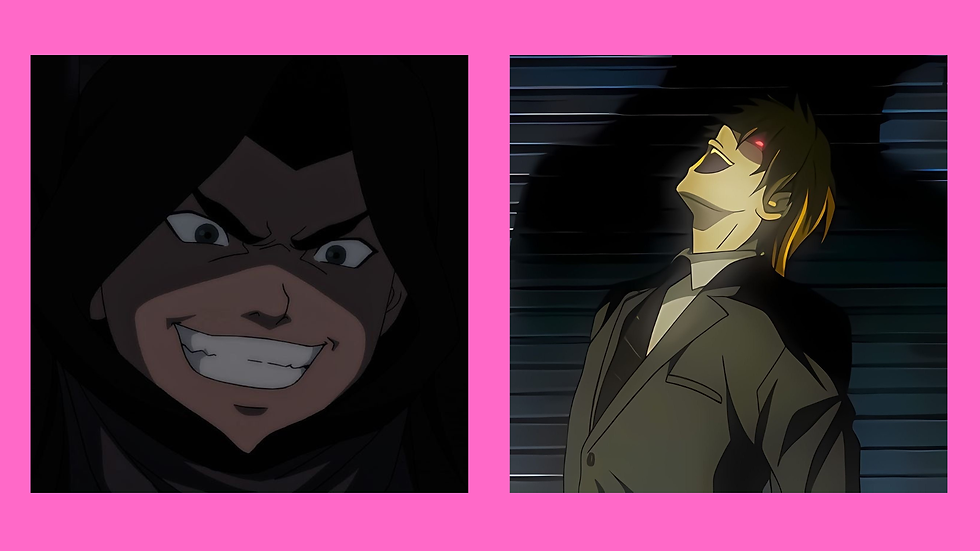
In Death Note, writer Tsugumi Ohba designed Light Yagami as an idyllic, hyper-intelligent student whose perfection was so absolute it verged on clinical boredom. Light was not born into crime or tragedy; he was the golden child of Japanese society, a top-ranking scholar, an athletic marvel, and the son of an incorruptible police chief.
His perfection made his descent into divine narcissism feel less like a corruption and more like an inevitability when handed total authority. The Death Note was not the source of Light's corruption; it was simply the key that unlocked a latent hubris waiting for a tool large enough to match his ego.
A common misconception in pop culture analysis is that the Death Note corrupted Light Yagami. In reality, the supernatural notebook was not the origin of his god complex it was simply the catalyst. Even in the very first scenes of Death Note, before the notebook falls from the sky, Light is psychologically fractured.
He experiences a profound sense of emotional detachment, apathy, and disgust toward the world around him. He views his high school peers, his family, and Japanese society through a lens of extreme condescension. He was already a prodigy suffocating under the weight of his own boredom, harboring a subtle sociopathy and a belief that he possessed superior judgment.
The Death Note did not invent Light's god complex, it merely gave tools to a deeply troubled teenager the execution power to match his pre-existing messiah delusion. Operating in complete isolation, his narcissism was never checked by a mentor or an immovable moral boundary. His intellectual rivalry with L was purely tactical a high-stakes game of chess where victory was measured in body counts rather than ethical growth. Light mistook his tactical luck for divine mandate, even if he wasn't kira he'd still be rivaling L just from his ego and believing he can bring kira to justice.
This unchecked hubris led to the iconic fatal evolutionary spiral. As the series progressed, Light shifted from executing violent criminals to murdering innocent investigators, police officers, and allies who threatened his secrecy.
His pre existing lack of empathy disappeared until he became completely paranoid and isolated. When his plan inevitably fractured under the weight of his own overconfidence, Light suffered a desperate, pathetic breakdown on a warehouse floor, begging for his life before Ryuk wrote his name in the notebook. His god complex present long before he picked up the Death Note proved to be a fatal, self-cannibalizing dead end.
Conversely, when Grant Morrison introduced Damian Wayne to the DC Universe in 2006, the objective was to shatter Batman’s carefully structured worldview with an unyielding genetic mirror. Damian was artificially gestated in a lab by Talia al Ghul and genetically modified to be a lethal apex predator. Raised from infancy by the League of Assassins, Damian was conditioned to view combat, strategy, and execution not as skills, but as basic biological functions the same way we see walking, jumping, and running.
Both Ohba and Morrison birthed their characters into fiction not merely as exceptionally skilled youth, but as walking absolutes, prodigal teenagers burdened with the absolute certainty that justice is not something to be served, but something they inherently embody.
Upon their respective debuts, both characters instantly established an unyielding moral binary that placed them above ordinary humanity mindset. Light Yagami looks down at the criminal rot of society and concludes that human law is fundamentally flawed because it is constrained by morality and due process.
Adopting the alias "Kira," Light assumes the mantle of absolute judge, deciding that his personal intellectual superiority grants him the divine right to decide who lives and who dies.
While Damian Wayne enters Gotham City with an eerily similar posture of absolute superiority. Arriving at Wayne Manor, he views Bruce Wayne’s non-lethal mandate not as moral discipline, but as an inefficient, cowardly weakness. Damian genuinely believes that his royal bloodline, combining the tactical brilliance of Bruce Wayne with the global ambition of Ra's al Ghul makes him the rightful heir to crime-fighting, superior to every Robin who came before.
Neither character tolerates gray areas, and both exhibit the classical, terrifying traits of a god complex:
Intellectual Entitlement: A belief that their analytical capabilities elevate them above the moral judgment of society.
Rigid Absolutism: Viewing human life through a binary lens of "useful" versus "expendable."
Resistance to Authority: A total refusal to yield to institutional rules, elders, or established codes of conduct, believing themselves to be the ultimate authority.
The Evolutionary Dead End: Light Yagami’s Fatal Descent
( repeated from top )
Where the two characters diverge and where the core question of survival rate emerges is in how their respective environments responded to their narcissism.
Light Yagami’s environment unwittingly enabled his god complex until it completely consumed his humanity. Operating in absolute isolation behind the supernatural anonymity of the Death Note, Light’s ego was never challenged by an unyielding moral mentor. His intellectual rivalry with L was purely tactical, a high-stakes game of chess where victory was measured in body counts rather than ethical growth. Without a structural boundary or emotional anchor to check his arrogance, Light mistaken his early tactical success for divine calling.
This unchecked hubris led to a dramatic reduction in his psychological survival rate. As the series progressed, Light shifted from executing violent criminals to murdering innocent investigators, police officers, and allies who threatened his secrecy.
His god complex rotted his capacity for empathy, leaving him completely paranoid and isolated. When his plan inevitably fractured under the weight of his own overconfidence, Light did not die with dignity, he suffered a desperate, pathetic breakdown on a warehouse floor, begging for his life before Ryuk wrote his name in the notebook. His god complex proved to be a fatal evolutionary dead end a self-cannibalizing ego that destroyed its host.
Escaping the Fate: Damian Wayne and the Collision with Humanity
Damian Wayne, however, narrowly skipped that exact same tragic trajectory not because his ego was smaller, but because his god complex collided with an immovable object.
Damian’s salvation was his introduction to Batman and the Bat-Family. Where Light operated in total isolation, Damian was thrust into an environment where his lethal entitlement was met with immediate, unyielding resistance.
Bruce Wayne refused to allow Damian to kill, stripping him of his assassin tools and forcing him to adopt the non-lethal mantle of Robin. This forced transition required Damian to unlearn his genetic conditioning and confront the reality that true strength lies in restraint, not execution.
Furthermore, Damian was provided with emotional anchors that Light lacked most notably Dick Grayson (Nightwing), who acted as a compassionate older brother during Damian’s initial tenure as Robin. Through community, accountability, and the weight of a father’s love, Damian was forced to dismantle his own divine entitlement. He surrendered his belief that he was an absolute ruler in exchange for learning how to be a son, a teammate, and ultimately, a hero seeking justice not vengeance.
but.. could Light Yagami been worse than Damian Wayne.
The Spectrum of Ego: Light’s Malignant Narcissism vs. Damian’s Defective Indoctrination
To truly understand why their trajectories diverged, one must measure the raw depth of their narcissism. Light Yagami operates on a tier of malignant narcissism that Damian Wayne, despite his arrogance, never reaches.
Light’s grandiosity is pathological and sociopathic. He masks his superiority complex behind polite smiles and top-tier test scores, viewing every human relationship including his own family as purely instrumental. ( ex. not caring when his father died infront of him )
People are not individuals to Light they are either worshipers, chess pieces, or obstacles to be eliminated. He lacks the capacity for genuine remorse, viewing his killings not as tragic necessities, but as proof of his divine standing.
Damian Wayne’s narcissism, by contrast, was an environmental armor rather than an unchangeable personality trait. Raised in an isolated cult of assassins and the king of narcissism, Damian was conditioned to project absolute perfection as a survival mechanism. Yet, beneath his explosive arrogance lies a child capable of deep loyalty, genuine affection for his family, and profound empathy for animals and innocents. Where Light’s narcissism metastasized into absolute ruthlessness and zero boundaries except a slight soft spot for his sister Sayu Yagami, Damian’s ego was softened by his underlying desire for love and moral legitimacy.
Light wanted to be worshipped as a god, Damian simply wanted to be worthy of his father’s cape.
Light Yagami (Malignant/Covert Narcissism): Light’s narcissism is terrifying because it hides behind a mask of high-society perfection, politeness, and civic duty you can encounter someone like him any day in your life. He genuinely believes he is a higher species of human who deserves worship as a literal deity. He feels zero genuine empathy, sees every single human being (even his own father and sister) as disposable pawns, and never experiences true remorse only frustration when his brilliance isn't validated he had no reason to act the way he did unlike Damian who was raised in it.
Damian Wayne (Grandiosity & Defense Mechanism): Damian’s narcissism is loud, overt, and largely a product of severe indoctrination and childhood trauma. He was bred in a lab and conditioned by assassins to believe he was superior he was raised to think that way. However, under that spiky exterior, Damian actually possesses a conscience, a desperate need for connection, and the ability to feel loyalty, shame, and love.
The Remorse & Empathy Test
When Light hurts people, he feels a surge of superiority for outsmarting them. He uses affection purely to manipulate (like his treatment of Misa Amane).
When Damian hurts people or fails, he eventually learns to feel remorse he has always felt guilt about his doings in the league of assassins. He actively chooses to change because his empathy though buried deeply at first is real.
Light Yagami cannot submit to anyone or anything. In his mind, even the gods of death are just tools for his reign.
Damian Wayne demonstrates the ultimate defeat of total narcissism, he willingly yields to Batman's moral code, accepts criticism, and takes on the role of Robin a position inherently built on partnership and service rather than total dominance.
End Note: The Spectrum of Narcissism and the Shield of Connection
Ultimately, narcissism is a spectrum like no other, one that slides quietly from healthy self-confidence into a destructive, isolated delusion if left unchecked.
Constantly feeding one's own ego creates a feedback loop of superiority that isolates the individual from reality. As Light Yagami demonstrated, an overinflated ego tricks a person into believing they are beyond critique, beyond help, and above the people around them. It turns the mind into a fortress where empathy dies and self-destruction becomes inevitable.
The crucial difference between Light’s tragic end and Damian’s evolution proves that reaching out submitting to family, community, and genuine human connection is the ultimate safeguard against falling into Light’s fate.
Ego thrives in isolation, but it dissolves in the presence of accountability and love. When we allow ourselves to be anchored by the people who truly care for us, we trade the fragile, lonely illusion of being a "god" for the enduring strength of being human. Boosting your ego might feel powerful in the short term, but keeping yourself grounded is what actually saves you.
Comments